Showing posts with label Genre: General Fiction. Show all posts

Wednesday, 25 July 2012

The Solitude of Prime Numbers by Paolo Giordano


Title: The Solitude of Prime Numbers

Author: Paolo Giordano

Date Read: 11.July.2012

On TBR for: 397 days (or 1 year, 1 month and 1 day. Also 397 is prime)

Format: Mass trade paperback

Source: Bought at a bookfair: Feira do livro do Porto 2011

Challenges: 2012 Outdo Yourself, Off the Shelf 2012


Before beginning the review proper, I'll just leave this gif here because it's relevant:
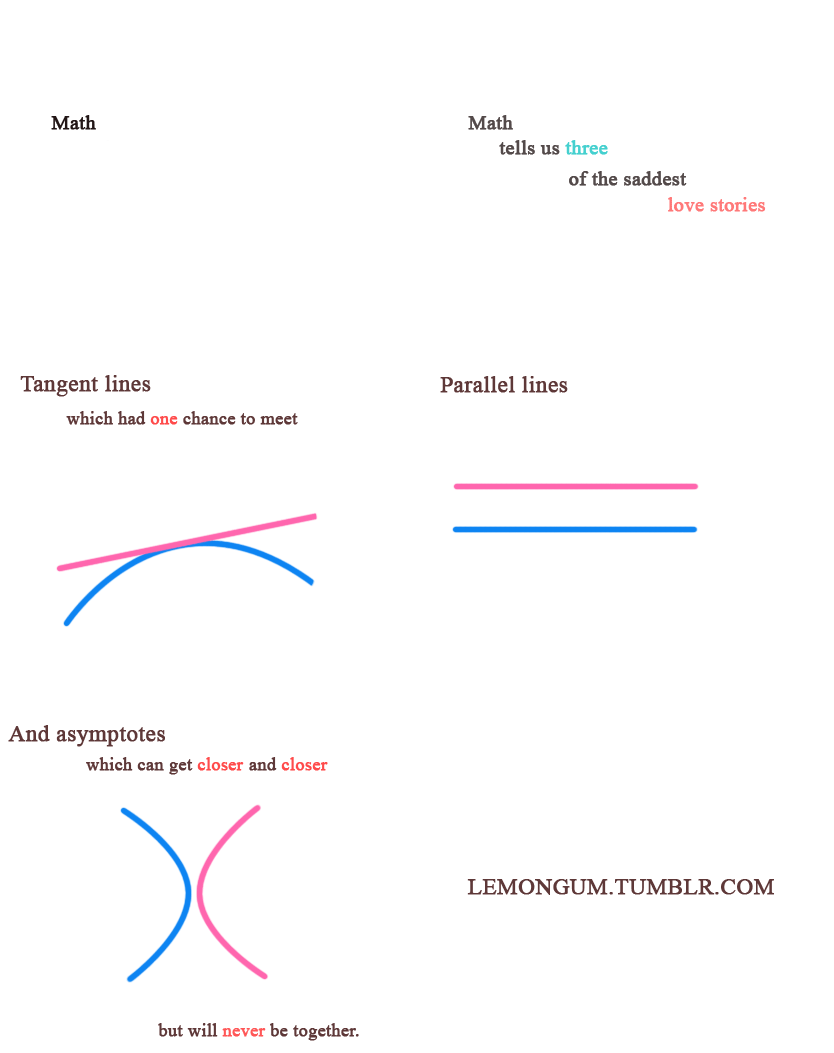


The Solitude of Prime Numbers tells us the stories of Alice and Mattia, from when they were young and something tragic happened to each of them, to how they grew, met, and went their own ways. They are pretty lonesome people, they have their own quirks and weirdness about them, which means that this is not a happy sort of book.

Yet it is a good book. Maybe it's the way these stories, or episodes of two lives, are told which makes it quite easy to turn each page, wanting to know more. Maybe it's the fact that some part of me can't help but relate with the solitude of these two characters. The writing is both beautiful and simple (I would say beautifully simple), but manages to convey how different, and sometimes how desperate both Alice and Mattia are. And since we follow them since early childhood into adulthood, we see how they change, how they grow (or do not grow), and how some choices can have repercussions for the rest of a life.

I confess that the reason I was drawn to this book was its title. It's nerdy and quirky, quite up my alley. And I am glad I did end up reading it. Maybe not the most cheerful of reads, but it's a good and enjoyable one.

Rating: 4 out of 5

Other Reviews: The Unread Reader 

This Book on: LibraryThing | GoodReads | BookDepository UK | Book Depository US | Amazon UK| Amazon US| Wook | Wook

Tuesday, 14 December 2010

The Curious Incident of the Dog in the Night-time by Mark Haddon

The Curious Incident of the Dog in the Night-time
The Curious Incident of the Dog in the Night-time (what a big name!) is indeed a curious book. Told from the point of view of a teenager with Asperger's Syndrome, Christopher, it is extremely different from all the books I've read.

It starts with Christopher discovering his neighbour's dog dead in the middle of night. And because Christopher likes detective novels, especially Sherlock Holmes, he will investigate this case to find who is the culprit.

This book was fun at first, full of quirks and things that made you think. It was amazing to see the world in such a different way, where what you say is what you mean, with no metaphors. Christopher is a wonderful character that I couldn't help to like, and with his love for science and maths, I even learnt some new things! His interactions with other people, especially strangers, were really fun to read. However I had some trouble seeing him as fifteen, I kept imagining him a bit younger.

I loved the detective part of the book, finding out all the clues to discover who killed Wellington, the dog. There were other mysteries attached to that one that we couldn't help but notice (and solve, even if Christopher couldn't). But again, there is a downside to this as well, as the the discovery of the dog killer is disappointing, because is not a result of Christopher powers of deduction, but exasperation of the guilty one that finally confesses.

And this brings me to the second part of the plot: Family Drama. After finding out who killed Wellington, Christopher's world is throw off balance, and he flees home. He will continue to investigate things, solving his own mysteries. This part was nice at start but it started to get to much drama for my tastes, especially when compared with the beginning of the book. Also, the quirks that I enjoyed at first became repetitive and lost their charm.

The book is quite is easy to read. The language is simple and to the point, and you want to read just one more chapter every chapter. When I reached the point where the book lost its charm, it was still easy to finish it – I just stopped loving it.

The Curious Incident of the Dog in the Night-time is a nice book, that I'm glad I've read.

(3.5/5)

Other reviews: Page Turners | Reading with Tequilla

Saturday, 10 July 2010

Kafka on the Shore by Haruki Murakami

Kafka on the Shore

Kafka on the ShoreAs I said before, Kafka on the Shore is a very strange book. It was loaned to me (thrust my way, that is) by a friend singing its praises and saying it was just like an anime.

The backcover reads: Kafka on the Shore tells the adventures (and misadventures) of two strange characters, whose lives, running side by side throughout the novel, will eventually prove to be full of enigmas and mystery. These are Kafka Tamura, who runs away from home at age 15, pursued by the shadow of a dark prophecy that one day was launched by his father, and Nakata, an elderly man who has never recovers from a freak accident he suffered as a young man and who has devoted much of his life to a cause - seeking missing cats.

This oversimplifies a lot.

It is true that these two characters' lives run parallel to each other, almost meeting in the end. But Kafka's journey is not simply that of a runaway kid, he is running away from an Oedipal prophecy, made by his own father (who has quite a few screws loose). He will take refuge in Komura Library, where he meets Oshima with whom he has philosophical and metaphysical conversations about life, literature and music (in fact, these made me want to read more Japanese literature - I've added Akinari Ueda's Tales of Moonlight and Rain to my wishlist, and started Kawabata's Snow Country). Kafka's tale is mostly of coming of age, and becoming strong to be able to survive the world.

Nakata's story, together with the reports of the incident that left him unable to read and write, or learn anything, but with the strange gift of talking to cats, is amusing at first, but growing more deep and poignant as the chapters advance. Nakata is responsible for most of the surreal things happening in the book, although it is not really his fault if it rains fishes, or leeches. I really liked Nakata, and his relationship with all the characters that he meets. He is really a nice old man, who isn't very bright, but is quite happy that way. But what starts with a quest to find a missing kitty, ends up being the journey of his life, setting right what was wrong.

And between these two characters there is Miss Saeki, a connecting point between the stories, a woman for whom time has stopped, in the sense that she stopped living, only being able to exist after the death of her fiancé. She will be important to Kafka, helping him become the “world's toughest 15-year old”, and the ending point of Nakata's quest.

When I finished the book, I wasn't sure I had liked it. I wasn't sure I disliked it either. It's the kind of read that needs digesting, that you can only know how much it touched you when, 6 months later, you still recall the story and the feelings associated with it.

What is great about Kafka on the Shore is that I was there with the characters, in the same places they where, having the same adventures as them. It is not that I loved the book, it wasn't that great, I just didn't want to leave that world. I would love to keep going to Komura Library with Kafka, having lunch and conversations with Oshima, or walk on the forest, with trees looming over me, or even keep going west with Nakata and Hoshino, and talking with cats.

(4/5) - for now, we'll see in 6 months how I'll feel about it

Wednesday, 30 June 2010

The Legend of Sleepy Hollow and Other Stories by Washington Irving

The Legend of Sleepy Hollow and other stories
The Legend of Sleepy Hollow and Other Stories (Thrift Edition)
I've wanted to read the Legend of Sleepy Hollow for quite some time, so when I found this book at a good price I had to buy it. I guess I should have made my homework before picking this up: The Legend of Sleepy Hollow is a very short story, from where Tim Burton took the generic idea, and expanded it. It is quite nice, but it was a surprise as it is very different from the movie. Basically, the characters are there, the place is the same, the lore of the place is the same, but Ichabod Crane's backstory and what really happens is different.

Some of the other stories in this book were very nice: Rip Van Winkle was amusing and fairytale like, The Spectre Bridegroom was eerie but very sweet, The Wife was simply sweet and romantic, Adventure of a Mysterious Stranger and The Story of the Young Italian were very good and tragic, and The Mutability of Literature, although not really a story, was interestingly actual, although it relates with the printing press. Here's a quote:
"But the inventions of paper and the press have put an end to all these restraints. They have made every one a writer, and enabled every mind to pour itself into print, and diffuse itself over the whole intellectual world. The consequences are alarming. The stream of literature has swollen into a torrent—augmented into a river-expanded into a sea. "
What would have Irving said about the Internet, if he could only see it?

The other stories (Mountjoy, Adventure of the German Student, The Adventure of my Uncle, The Adventure of my Aunt, The Devil and Tom Walker) were not so good, most of the time boring and seeming to drag for ages. Westminster Abbey was especially boring, and I almost skipped it ahead because I hardly could read a paragraph at a time without my mind drifting to a much more interesting topic.

I liked Irving's writing style, a third-person that is not detached from action, with a somewhat conversational style. It seemed like he was telling me a story. This alone made the good stories great, and the not so good, enjoyable at least in a language level.

A complaint I have about this edition is: Why did they separate the stories Adventure of a Mysterious Stranger and The Story of the Young Italian when they are obviously parts of the same? The Adventure of my Uncle and The Adventure of my Aunt were not separated, and their connection is far more tenuous.

Final Opinion: It was an OK book; some good stories, some bad, one awful.

(3.5/5)